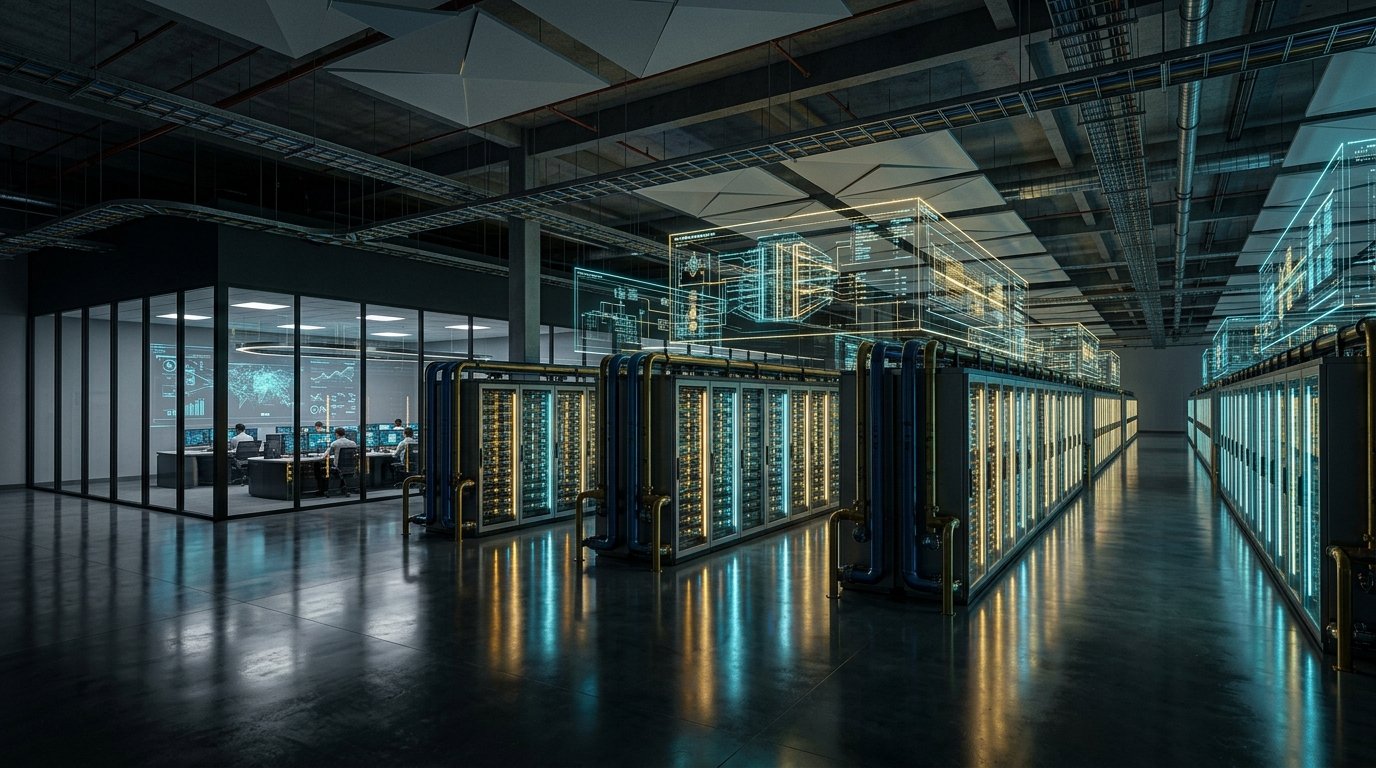
Data center resilience AI provides autonomous operational frameworks, predictive telemetry, and closed-loop control systems designed to safeguard mission-critical compute infrastructure against catastrophic thermal runaway, power grid fluctuations, and cascading hardware failures.
As the rapid expansion of frontier neural networks elevates computing demands to unprecedented levels, traditional facility architectures are confronting acute physical limits. Next-generation accelerator architectures—such as multi-node GPU clusters and dedicated tensor processing fabrics—routinely generate rack thermal densities exceeding 100 to 300 kilowatts. Under these extreme workloads, the cost of an unexpected disruption extends far beyond financial losses; a single power sag or thermal shutdown during a multi-week foundation model training checkpoint can corrupt distributed model weights, burn millions of dollars in compute cycles, and derail release timelines across modern hyperscale data center infrastructure.
1. The 100kW+ Thermal Frontier & The Collapse of Reactive Maintenance
For decades, enterprise data centers relied on static facility management protocols: predetermined scheduled maintenance windows, manual component inspections, and conservative thermostat thresholds. However, high-density AI clusters exhibit non-linear thermodynamics and volatile, instantaneous power spikes that render calendar-based maintenance obsolete. When thousands of tensor cores simultaneously spin up to execute matrix multiplications, localized temperature gradients surge within milliseconds, overwhelming conventional chilled-air handling units.
Modern resilience engineering replaces periodic manual routines with continuous, high-frequency IoT telemetry. Sensor arrays monitor ambient air pressure, coolant dielectric purity, pump vibrations, and individual optical transceiver temperatures every second. By applying machine learning models trained on historical failure signatures, facility managers transition from reactive firefighting to prescient risk mitigation, integrating with broader autonomous enterprise AI agent orchestration pipelines that dynamically migrate computational loads away from degrading server nodes.
2. Predictive Anomaly Detection & Component Failure Forecasting
Unplanned downtime in hyperscale facilities typically originates from mechanical and electrical failure points that give subtle warning indicators long before complete breakdown. Data center resilience AI platforms specialize in identifying these microscopic acoustic, thermal, and harmonic anomalies:
- Uninterruptible Power Supply (UPS) & Battery Degradation: Machine learning algorithms continuously analyze internal cell impedance, voltage discharge curves, and ambient thermal cycling. By identifying early signs of dendrite growth and electrolyte depletion in lithium-ion and VRLA battery strings, AI platforms predict cell failure 48 to 72 hours before catastrophic thermal runaway occurs.
- Cooling Distribution Units (CDUs) & Fluid Dynamics: Direct-to-chip liquid cooling systems require sub-millimeter flow precision. Convolutional neural networks evaluate differential pressure drops across microchannel cold plates and analyze acoustic frequency data from manifold pumps to detect cavitation, micro-leaks, and particulate clogging before cooling capacity degrades.
- Backup Generators & Mechanical Switchgear: Acoustic sensors combined with time-series anomaly detection monitor diesel generator cold-start telemetry and transfer switch vibrations, flagging lubrication anomalies and mechanical friction well in advance of emergency grid cutovers.
Applying structured diagnostic methods to hardware failure mirrors the rigorous analytical disciplines established in probabilistic risk modeling and failure mode analysis, allowing engineering teams to separate random sensor noise from true early-stage degradation.
Architectural Insight: Closed-Loop AI Telemetry & Predictive Thermal Throttling
Traditional facility cooling operates on reactive PID (proportional-integral-derivative) feedback loops, modulating fan and pump speeds only after physical thermometers register temperature climbs. In contrast, modern AI resilience architectures leverage physics-informed neural networks (PINNs) paired with real-time computational fluid dynamics (CFD) digital twins. By correlating incoming neural training job queues and GPU power envelopes 60 to 120 seconds before heat transfers to the cold plate, closed-loop controllers preemptively increase coolant flow velocity, flattening thermal spikes, eliminating thermal throttling, and reducing auxiliary cooling energy overhead by up to 25%.
3. Digital Twins & Closed-Loop Liquid Cooling Optimization
Direct-to-chip liquid cooling and two-phase immersion tanks are now standard requirements for 2026 AI infrastructure. However, managing circulating dielectric fluid and chilled water across tens of thousands of server blades introduces complex hydraulic balances. A digital twin creates an exact, real-time computational replica of the entire physical plant—incorporating weather conditions, thermal exhaust plumes, and fluid dynamics.
Deep reinforcement learning (RL) agents continuously interact with this digital twin to calculate optimal setpoints across cooling towers, chillers, and variable-frequency pumps. Rather than maintaining static margins of safety that waste gigawatt-hours of power, the AI model adjusts valve positions and compressor speeds in real time. This dynamic balancing prevents localized hot spots while drastically reducing Power Usage Effectiveness (PUE) from historical industry averages of 1.5 down toward 1.1 or lower.
4. Electrical Grid Resilience, Peak Capping & Microgrid Integration
Power availability has eclipsed raw hardware acquisition as the primary bottleneck for data center operations. Hyperscale campuses demanding 500 megawatts to 1 gigawatt of dedicated electrical capacity frequently strain municipal power grids. Here, resilience AI acts as an intelligent energy broker:
- Dynamic AI Power Capping: When utility grids experience peak demand or sudden frequency drops, AI power orchestration systems dynamically cap non-critical background jobs, clocking down secondary compute nodes without interrupting primary model training passes.
- Autonomous Microgrid Orchestration: Hyperscale sites increasingly deploy localized Battery Energy Storage Systems (BESS), solar arrays, hydrogen fuel cells, and small modular nuclear reactors (SMRs). Reinforcement learning algorithms monitor real-time wholesale electricity pricing, weather forecasts, and grid stability indices, autonomously switching between utility feeds and on-site reserves to ensure zero operational interruption.
- Cyber-Physical Threat Isolation: Modern data center facilities are target zones for sophisticated physical and network intrusions. AI security telemetry monitors industrial control systems (SCADA/Modbus) for anomalous command injection, safeguarding against malicious actuator tampering in tandem with robust enterprise AI security and threat mitigation protocols.
Comparative Overview: AI Resilience Mitigation Matrix
The table below summarizes how AI resilience architectures address critical data center failure modes compared to legacy operational methodologies:
| Operational Domain | Traditional Facility Approach | AI-Driven Resilience Architecture | Measurable Business Impact |
|---|---|---|---|
| Thermal & Liquid Cooling | Static setpoints & reactive PID thermostatic adjustments | PINN digital twins & predictive computational fluid dynamics | 15–25% reduction in cooling energy; zero thermal throttling |
| Battery & UPS Backup | Scheduled calendar replacement (every 3–5 years) | Real-time electrochemical impedance & discharge telemetry | Failure predicted 48–72h in advance; 30% extended battery life |
| Power Grid Volatility | Passive diesel generator cutover upon utility failure | Autonomous microgrid dispatch, BESS arbitrage & dynamic power capping | Zero-interruption compute; 20% lower electricity procurement cost |
| Fluid Leak & Pump Health | Physical spot checks & basic threshold float sensors | Acoustic harmonic tracking & micro-pressure drop analysis | 99.4% early leak detection rate prior to server blade contact |
| Hardware Cluster Diagnostics | Post-crash kernel dump inspection and manual rebooting | Predictive GPU memory error rate analysis & preemptive checkpointing | Prevents corrupted training runs, similar to catching synthetic AI hallucination and reasoning failure modes |
While central data centers shoulder enterprise model training, edge hardware handles local inferencing tasks explored in our review of the HP ProBook 4 G1i AI PC architecture.
Infrastructure Reliability, Server Response Time (TTFB), and Search Performance
While data center resilience is traditionally viewed as an enterprise IT concern, infrastructure stability directly dictates organic search engine visibility. Google's search crawlers operate under dynamic crawl budget allocations that expand or contract based on server responsiveness.
When hosting clusters suffer thermal throttling or power failover latency, server response times (Time to First Byte or TTFB) spike. High TTFB latency directly degrades Core Web Vitals performance and signals to search spiders that the host cannot sustain intensive crawl frequencies. Integrating predictive AI diagnostics into cloud facility management ensures 99.999% uptime, preserving crawl efficiency and protecting search rankings. For detailed diagnostic protocols, review our comprehensive framework in technical SEO audits and crawl budget optimization.
Conclusion
Implementing data center resilience ai is no longer an optional efficiency optimization; it has become the existential backbone of high-density artificial intelligence infrastructure. As next-generation GPU clusters push thermal envelopes past 100 kilowatts per rack and regional power grids reach historic capacity constraints, conventional reactive maintenance and static cooling schedules are fundamentally unviable. By deploying continuous anomaly detection, physics-informed digital twins, and closed-loop microgrid orchestration, hyperscalers can insulate mission-critical compute against catastrophic power fluctuations, coolant leaks, and cascading component failures. The future of resilient infrastructure lies in autonomous operations where self-healing facilities dynamically throttle workloads, pre-cool cooling distribution loops, and schedule mechanical replacements days before an outage occurs. Engineering leaders must move aggressively from periodic inspection checklists to unified telemetry ecosystems that fuse server diagnostics with facility power architecture. Organizations that master autonomous data center resilience will not only eliminate millions in unplanned downtime costs but also build the sustainable computational foundation required to power the global generative economy.
Frequently Asked Questions (FAQ)
What is data center resilience AI and why is it essential in 2026?
Data center resilience AI refers to autonomous machine learning frameworks that monitor, predict, and optimize facility operations in real time. It is essential in 2026 because modern AI compute clusters generate extreme thermal densities (100kW+ per rack) and volatile electrical loads that traditional manual and reactive management cannot safely handle.
How does AI predictive maintenance prevent catastrophic data center outages?
Predictive AI analyzes high-frequency sensor streams—such as battery impedance, acoustic vibrations in pumps, and micro-pressure fluctuations in coolant loops. By detecting anomalies 48 to 72 hours before physical failure occurs, operators can repair or replace degrading hardware before disruptions impact running compute jobs.
Why are traditional air cooling systems inadequate for AI hardware?
Air cooling is thermodynamically limited to approximately 30 to 40 kilowatts per rack due to the low thermal capacity of air. Frontier AI clusters routinely exceed 100 kilowatts per rack, necessitating direct-to-chip liquid cooling or immersion systems where AI closed-loop control optimizes flow rates and heat rejection dynamically.
What is a data center digital twin and how does it optimize operations?
A digital twin is a real-time virtual simulation of the data center's thermodynamic, electrical, and mechanical state. Powered by physics-informed neural networks, it allows autonomous control agents to test cooling and power adjustments virtually before executing them physically, reducing energy consumption by 15% to 25%.
How does resilience AI assist with electrical grid integration and power capping?
During utility grid brownouts or peak-demand pricing spikes, AI power capping systems intelligently clock down non-critical background processes while dispatching on-site batteries or microgrid reserves. This prevents facility circuit trips while safeguarding continuous execution of mission-critical neural model training.

Abdul Samad
Founder and Lead Search Strategist at BacklinkBlend. Based in Hyderabad, Pakistan, Abdul Samad has over 6 years of hands-on experience in organic link building architectures, technical SEO diagnostics, Generative Engine Optimization (GEO), and algorithmic search audits.