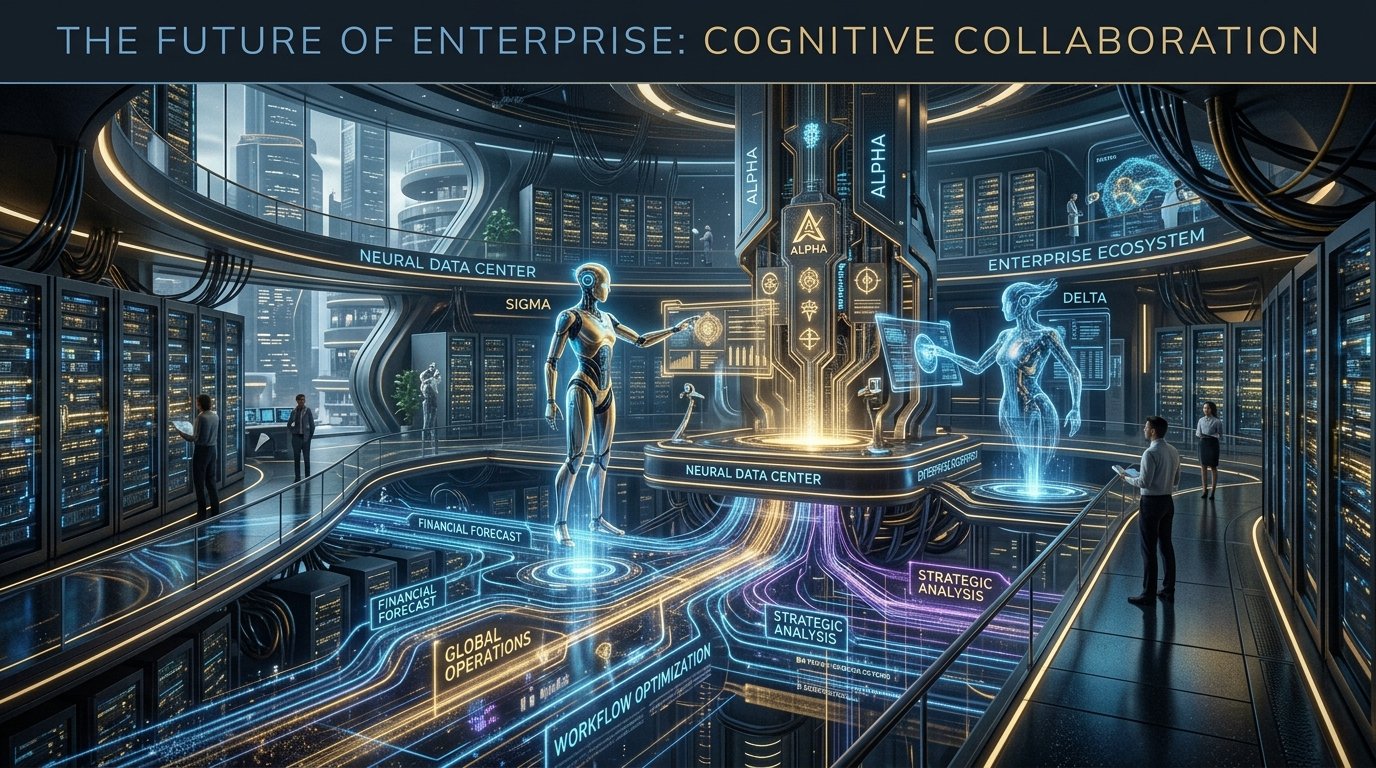
Enterprise AI agents represent the vanguard of autonomous workplace automation—transitioning artificial intelligence from passive, single-turn conversational chatbots into persistent, goal-oriented cognitive systems capable of independently executing complex, multi-step business workflows.
Unlike standalone Large Language Models (LLMs) that merely generate descriptive text upon receiving an isolated user prompt, enterprise AI agents possess proactive reasoning, long-term state memory, and native tool-use capabilities. By integrating with enterprise APIs, databases, and operational software, these agentic networks decompose high-level corporate directives into executable sub-tasks, coordinate across specialized multi-agent swarms, and continuously evaluate their own outputs. For a comprehensive look at defense architectures, review our blueprint on enterprise AI security frameworks and threat models.
The 4 Architectural Pillars of Enterprise AI Agents
Modern enterprise agentic deployments are built upon four fundamental architectural layers that elevate models from static inference engines to robust digital coworkers:
- Perception & Context Grounding: The ingestion layer that captures real-time data streams, enterprise vector embeddings, telemetry, and multimodal inputs to anchor agent decisions in verified institutional truth.
- Autonomous Reasoning & Decomposition: Cognitive planning loops (such as ReAct, Tree of Thoughts, and Plan-and-Solve) that enable the agent to break down ambiguous business objectives into granular, verifiable execution milestones.
- Secure Tool Execution & Action Spaces: Controlled interface connectors (REST APIs, SQL connectors, terminal environments, and enterprise ERP integrations) that permit the agent to enact changes within tightly sandboxed operational parameters.
- Persistent State & Memory Management: Dual-tier memory systems consisting of ephemeral working context and long-term semantic retrieval-augmented memory, allowing agents to retain historical precedent across continuous operational lifecycles.
Multi-Agent Orchestration: From Silos to Swarms
While single-agent systems excel at isolated micro-tasks (such as drafting code or summarizing research papers), complex enterprise workflows require multi-agent orchestration. In these topologies, specialized agents assume distinct organizational personas and collaborate dynamically:
In a financial reconciliation workflow, for example, an Ingestion Agent extracts line items from heterogeneous invoices; a Compliance Agent verifies figures against international accounting standards and historical general ledgers; a Critique Agent cross-examines discrepancies; and a Reporting Agent compiles executive summaries for human sign-off. To explore how autonomous agents verify biometric identity, examine our technical analysis on agentic AI, voice biometrics, and decentralized security.
Enterprise Governance, Zero-Trust & Alignment Guardrails
Deploying autonomous agents within regulated enterprise environments introduces novel risk vectors that legacy cybersecurity perimeters cannot adequately defend. Key governance imperatives include:
- Zero-Trust Agent Authorization: Every autonomous tool invocation must be governed by least-privilege role-based access controls (RBAC) and cryptographically signed session tokens. Aligning agent infrastructure with the official NIST AI Risk Management Framework (AI RMF) ensures systematic governance of autonomous operations without granting unbounded write permissions to critical production databases.
- Prompt Injection & Goal Hijacking Defense: Autonomous agents that parse external web content or untrusted customer emails are vulnerable to indirect prompt injection. Grounded in the OWASP Top 10 for Large Language Model Applications, engineering teams must enforce strict schema validation, context boundary isolation, and dual-layer sanitization filters across all untrusted inputs.
- Deterministic Human-in-the-Loop (HITL) Checkpoints: High-consequence actions—such as initiating wire transfers, deploying code to production clusters, or modifying customer contractual terms—must require cryptographically verified human authorization before execution.
- Deterministic Output Verification: Implementing automated verification layers to spot logical discrepancies and prevent synthetic inaccuracies. Review our technical guide on AI hallucination mechanics and mitigation frameworks to learn how truth grounding is enforced.
Leading Enterprise Frameworks in 2026
Enterprises evaluating agentic infrastructure in 2026 rely primarily on four production-grade orchestration platforms:
| Framework | Primary Architecture | Ideal Enterprise Use Case | State Management |
|---|---|---|---|
| LangGraph | Cyclic Graph State Machine | Complex multi-actor business processes with human-in-the-loop loops | Persistent checkpointing & time-travel debugging |
| CrewAI | Role-Based Agent Crews | Collaborative team simulation, market research, content workflows | Task-centric delegated state |
| Microsoft AutoGen | Conversational Multi-Agent | Code execution, interactive debugging, quantitative analysis | Conversational context threads |
| Semantic Kernel | Plugin & Connector Architecture | Deep integration into Microsoft 365, Azure, and C#/.NET enterprise ecosystems | Native enterprise memory connectors |
Executive Roadmap: Implementing Autonomous Agents Safely
To capture the productivity gains of enterprise AI agents while mitigating operational and reputational exposure, business technology leaders should adopt a three-phase deployment roadmap:
- Phase 1 — Read-Only Observability (Months 1–3): Deploy agents strictly in sandboxed environments with read-only access to corporate knowledge bases. Evaluate reasoning fidelity, track latency, and benchmark hallucination rates.
- Phase 2 — Supervised Action with HITL (Months 4–6): Grant agents access to non-critical internal tool APIs (e.g. ticket tagging, draft report generation, customer support response prep), requiring explicit human approval before any action is committed.
- Phase 3 — Autonomous Multi-Agent Workflows (Months 7+): Expand to collaborative multi-agent swarms with dynamic delegation, continuous observability telemetry, and automated compliance auditing.
Frequently Asked Questions (FAQ)
How do enterprise AI agents differ from standard chatbots?
Standard chatbots operate in single-turn reactive modes—answering user queries with text summaries. Enterprise AI agents are proactive, multi-turn reasoning engines equipped with long-term memory, tool APIs, and autonomous planning capabilities to execute complete operational workflows without continuous user prompting.
What are the primary security risks of autonomous agents?
The primary security risks include indirect prompt injection, unauthorized privilege escalation through external tool APIs, recursive execution loops leading to compute exhaustion, and data leakage across multi-tenant vector memory stores.
Can enterprise AI agents be deployed on-premises?
Yes. Using open-weights foundational models (such as Llama 3, Mistral, and DeepSeek) running on local enterprise GPU clusters alongside orchestration frameworks like LangGraph or AutoGen, organizations can maintain 100% sovereign data privacy without transmitting corporate data to public cloud APIs.
Editorial Conclusion & Future Outlook
Enterprise AI agents mark a monumental evolutionary leap in workplace architecture. Organizations that successfully transition from experimental chat interfaces to structured, governance-backed multi-agent collaboration will unlock exponential efficiencies across engineering, finance, and operational logistics. However, sustainable adoption requires uncompromising adherence to zero-trust permissions, rigorous human-in-the-loop oversight, and continuous alignment monitoring to ensure autonomous systems remain reliable, compliant, and secure.

Abdul Samad
Founder and Lead Search Strategist at BacklinkBlend. Based in Hyderabad, Pakistan, Abdul Samad has over 6 years of hands-on experience in organic link building architectures, technical SEO diagnostics, Generative Engine Optimization (GEO), and algorithmic search audits.