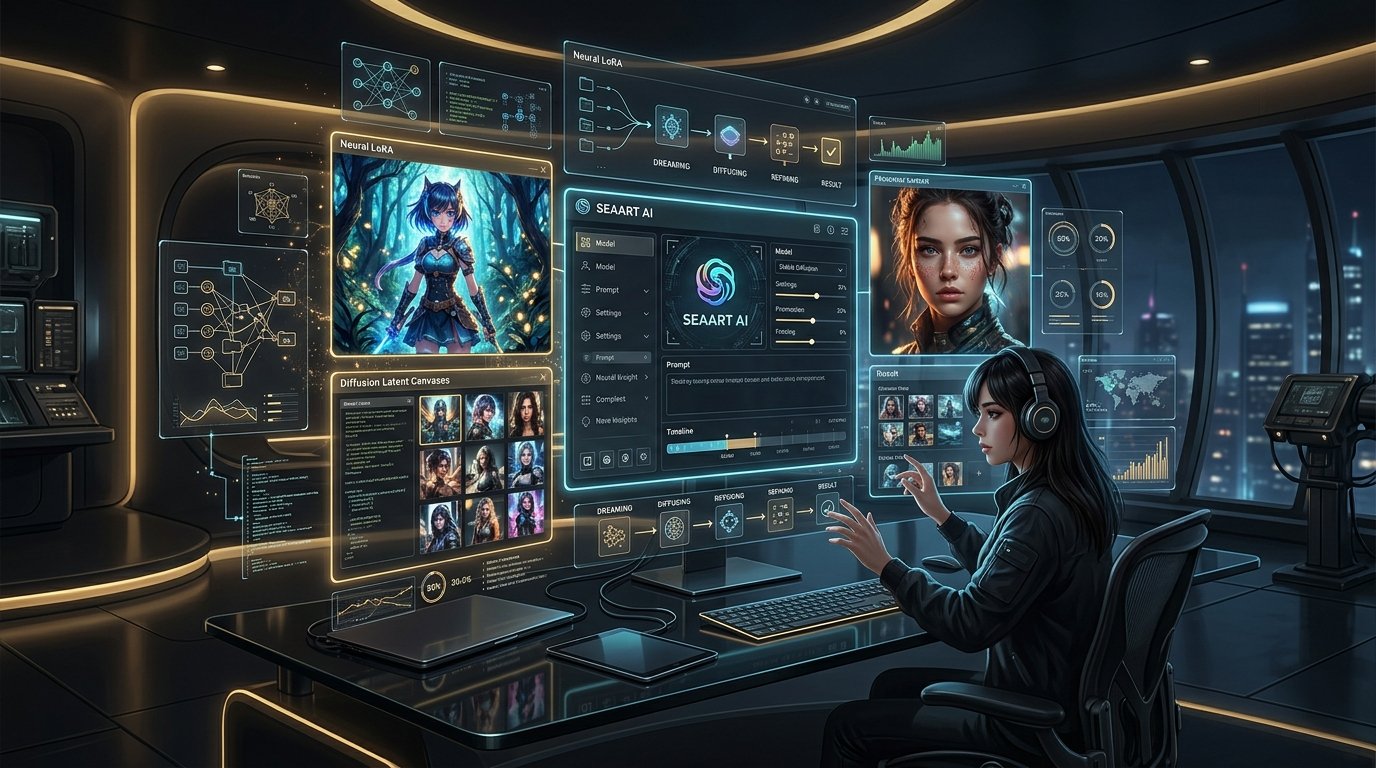
SeaArt AI (commonly searched as SeaArt) is an advanced cloud-native generative artificial intelligence platform engineered to create photorealistic digital imagery, stylized illustrations, and animated visual assets through an expansive library of community-trained diffusion models, LoRA checkpoints, and control vectors.
As the creative media sector shifts from centralized monolithic image generators toward decentralized, customizable neural synthesis, standalone generative platforms frequently erect steep paywalls or require prohibitively expensive local GPU hardware. SeaArt AI circumvents these barriers by delivering a browser-based, high-throughput rendering studio that hosts state-of-the-art open models alongside granular image manipulation modules. Whether crafting conceptual character designs, product visualization mockups, or stylized marketing collateral, creators can explore the official SeaArt AI platform to synthesize professional digital art directly from standard web browsers.
Core Capabilities: Multi-Model Diffusion, Cloud LoRA Training & ControlNet
SeaArt AI diverges from simplistic prompt-in, picture-out web utilities by providing a comprehensive suite of professional post-processing and conditioning tools:
- Multi-Model Diffusion Ecosystem: The studio supports diverse model families—including Stable Diffusion 1.5, SDXL, and frontier FLUX.1 checkpoints (Schnell and Dev). Creators can switch between hyper-realistic photographic base weights and anime or fantasy checkpoints with a single click. This versatility complements standalone synthesis tools such as the Deep AI image generation pipeline.
- Online LoRA Training & Repository: Users can upload 10–30 reference images directly into SeaArt's cloud environment to fine-tune custom Low-Rank Adaptation (LoRA) weights without typing Python code or managing CUDA dependencies. The community library also indexes hundreds of thousands of pre-trained LoRAs for instant costume, face, and architectural stylization.
- ControlNet & Precision Conditioning: Rather than relying solely on stochastic text interpretations, creators can enforce spatial composition using Canny edge detection, Depth maps, and OpenPose skeletal rigging. This ensures subjects match exact artistic postures, bridging the gap with character animation systems like the Remaker AI face swapping technology.
- Integrated AI Video & Inpainting Suite: Static renders can be expanded seamlessly using brush-based inpainting, background removal, 4K upscaling, or transformed into short cinematic clips utilizing spatiotemporal video models similar to platforms covered in our Hailuo AI video generator and Kling AI free video synthesis guide.
Architectural Insight: Multi-LoRA Merging & ControlNet Conditioning at Scale
In traditional local generation, stacking multiple LoRA adapters against an SDXL base model causes severe weight interference, artifact drift, and exponential VRAM spikes. SeaArt's cloud inference engine solves this through dynamic latent tensor merging: it dynamically scales cross-attention injection layers prior to the U-Net or DiT denoising loop. By decoupling LoRA weights into mathematically orthogonal sub-matrices and combining them with ControlNet structural guidance, artists can layer distinct character identities, lighting conditions, and apparel aesthetics in a single pass without model corruption.
SeaArt AI Stamina Economy & Updated 2026 VIP Subscription Matrix
SeaArt operates on a dual-resource framework featuring daily resetting Stamina for routine image rendering alongside persistent Credits/Coins for compute-heavy tasks such as cloud LoRA training and video generation. Crucially, unused daily Stamina does not accumulate or roll over at midnight; it refreshes every 24 hours:
| Plan / Tier | Pricing (At Time of Writing) | Daily Stamina / Generation Allowance | Key Features & Privileges |
|---|---|---|---|
| Free Creator Tier | $0 / Free | 60 – 150 Daily Stamina (via daily check-ins & quests) | Standard generation queue, access to baseline community models, public gallery renders |
| Beginner SVIP | ~$4.79 – $5.99 / Month | ~300 Daily Stamina (~1,500 images/month) | Priority queue access, ad-free canvas, commercial usage rights |
| Standard SVIP | ~$20.99 – $29.99 / Month | ~1,800 Daily Stamina (~9,000 images/month) | Up to 10 concurrent generation tasks, priority LoRA training, video generation support |
| Professional SVIP | ~$38.99 – $59.99 / Month | ~4,000 Daily Stamina (~20,000 images/month) | High-throughput batching, high-priority GPU clusters, expanded video generation |
| Master SVIP | ~$69.99 – $89.99 / Month | ~9,000 to 12,000+ Daily Stamina (~60,000 images/month) | VIP dedicated server routing, studio asset management, heavy custom model fine-tuning |
Mastering SeaArt AI Prompt Engineering & LoRA Weighting
Attaining pristine outputs in SeaArt requires structuring descriptive prompts that leverage tag-based conditioning alongside negative weighting, as detailed in our AI image generator prompt blueprint:
- Anchor the Subject & Stylistic Checkpoint: Match prompt syntax to your selected base model. For SD1.5 checkpoints, comma-separated Danbooru tags (e.g.,
1girl, solo, intricate armor, cinematic lighting) yield high fidelity, whereas SDXL and FLUX.1 respond optimally to natural language narrative prose. - Calibrate LoRA Trigger Weights: When activating community LoRA cards, avoid full
1.0weight defaults which frequently cause facial burnout or contrast crushing. Set trigger weights between0.6and0.8for harmonious blending with base checkpoints. - Enforce Rigorous Negative Prompts: Guard against common diffusion artifacts by specifying explicit exclusions (e.g.,
worst quality, low quality, normal quality, blurry, duplicate limbs, distorted hands, watermark). Note that when using FLUX checkpoints, negative prompt enforcement is minimal compared to SD1.5/SDXL. - Fine-Tune Sampler & Step Counts: Utilize DPM++ 2M Karras or Euler a samplers between 25 and 35 steps with a CFG scale of 7.0 for an optimal balance of structural sharpness and creative freedom.
Conclusion
The democratization of generative diffusion pipelines represents a watershed moment for visual media, and seaart exemplifies how cloud infrastructure can bridge complex machine learning models with accessible creative workflows. By removing the steep hardware bottlenecks associated with local Stable Diffusion environments, the platform enables digital painters, indie game animators, and growth marketers to deploy high-dimensional neural weights without technical friction. Its seamless fusion of community LoRA repositories, fine-grained ControlNet conditioning, and dual-currency stamina governance transforms abstract text prompts into production-ready digital assets. While competitors restrict users to rigid proprietary backbones, SeaArt's multi-checkpoint architecture preserves artistic agency across photorealistic, cinematic, and illustrative aesthetics. As generative AI shifts from novelty into mainstream design pipelines, platforms that empower users to train bespoke stylistic adapters while maintaining scalable rendering speeds will anchor the creative economy. For aspiring creators and agile digital agencies, engaging with SeaArt's daily recharge tier offers an optimal zero-risk sandbox to master multimodal prompt mechanics and elevate digital content workflows.
Frequently Asked Questions (FAQ)
Is SeaArt AI free to use?
Yes. SeaArt provides registered users with a complimentary allocation of approximately 60 to 150 stamina units daily via check-ins and community quests. This allows creators to generate dozens of high-quality images every day without entering credit card details.
What is the difference between Stamina and Credits in SeaArt?
Stamina is a daily generation fuel that expires and resets every 24 hours at midnight; it does not roll over. In contrast, Credits or Coins are persistent, non-expiring tokens used for heavy tasks like cloud LoRA model training, video generation, and ultra-HD upscaling.
Can I train my own custom AI models on SeaArt?
Yes. SeaArt features an integrated cloud LoRA training pipeline where users can upload 10 to 30 reference images to train customized character faces, art styles, or product assets directly on SeaArt's cloud GPUs without local software setup.
Can I use images generated on SeaArt commercially?
Users subscribed to VIP tiers receive commercial licensing rights for their creations. However, creators must review individual community LoRA and base model licenses, as some community authors restrict commercial monetization for specific checkpoints.
How does SeaArt AI compare to Midjourney and Stable Diffusion?
While Midjourney operates as a closed proprietary ecosystem and local Stable Diffusion requires expensive GPUs, SeaArt delivers the ideal balance: full browser access to open diffusion models, FLUX checkpoints, community LoRAs, and ControlNet tools on any device.

Abdul Samad
Founder and Lead Search Strategist at BacklinkBlend. Based in Hyderabad, Pakistan, Abdul Samad has over 6 years of hands-on experience in organic link building architectures, technical SEO diagnostics, Generative Engine Optimization (GEO), and algorithmic search audits.