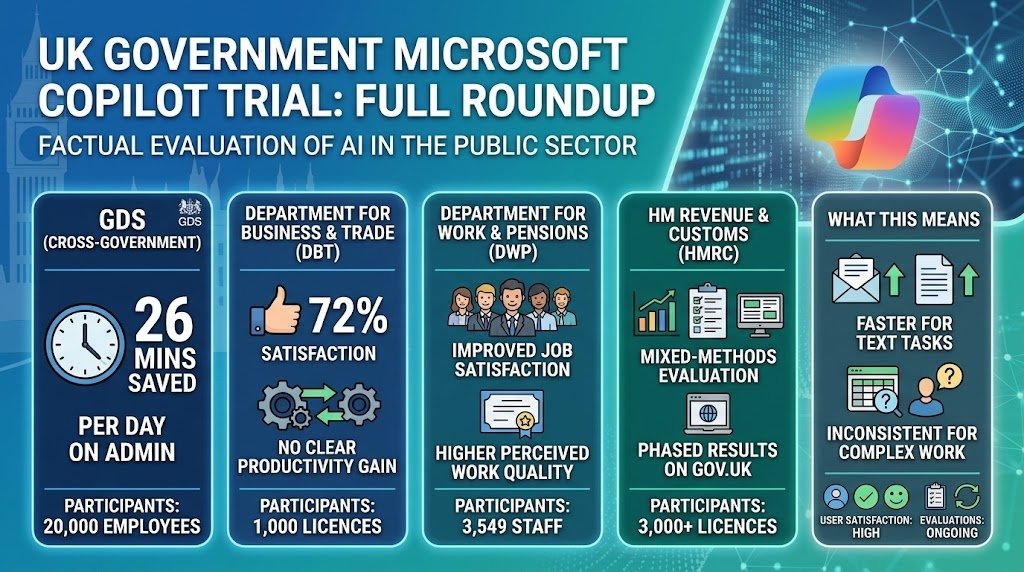
The UK government Microsoft Copilot trial represents one of the largest public sector evaluations of generative artificial intelligence in enterprise governance to date. Initiated across multiple civil service entities in late 2024 and continuing through 2026, these phased trials evaluated whether embedding AI-powered assistance into routine office workflows yields measurable operational efficiencies, improves document drafting quality, and enhances overall workforce satisfaction across government departments.
What Was the UK Government Microsoft Copilot Trial?
Public administration across the United Kingdom operates under complex regulatory, compliance, and security frameworks. As commercial generative AI tools matured, the Cabinet Office, Government Digital Service (GDS), and individual ministerial departments sought empirical data to determine whether deploying Microsoft 365 Copilot licences could automate repetitive administrative tasks without compromising output accuracy or data privacy.
Rather than executing a single uniform rollout, UK public sector bodies adopted distinct evaluation strategies. The trials encompassed broad cross-government experimentation coordinated by GDS alongside independent, department-specific research by the Department for Business and Trade (DBT), the Department for Work and Pensions (DWP), and HM Revenue and Customs (HMRC). Together, these pilots provide a comprehensive dataset on public sector AI adoption, revealing distinct performance outcomes across administrative, analytical, and ministerial functions.
The Cross-Government Trial Run by GDS
Deployment Scope and Participant Distribution
The largest single evaluation was organized by the Government Digital Service (GDS) from 30 September 2024 to 31 December 2024. This trial deployed 20,000 Microsoft 365 Copilot licences across civil servants in multiple public sector organizations, including central ministerial offices, the Welsh Government, the Office for National Statistics (ONS), and Companies House.
Self-Reported Admin Time Savings vs. Departmental Tracking
In findings published following the conclusion of the trial period, GDS reported that participating civil servants self-reported saving an average of 26 minutes per day on routine administrative tasks, such as drafting correspondence, summarizing lengthy meeting transcripts, and digesting policy briefs. Microsoft framed this self-reported figure as representing nearly two weeks of administrative time saved per employee per year. (Source: GDS Findings Report on GOV.UK)
However, official government documentation highlights a reporting discrepancy regarding the total number of participating bodies in the GDS initiative: DWP's official evaluation report cites 12 participating departments, whereas HMRC's evaluation report cites 11 participating departments. Because both statements originate from official GOV.UK publications, both figures reflect documented departmental records. Crucially, the 26-minute daily figure relies on subjective participant surveys focusing specifically on administrative tasks, rather than a controlled, objective baseline productivity measurement across all work duties.
The Department for Business and Trade (DBT) Trial
Pilot Execution and Sample Structure
The Department for Business and Trade (DBT) conducted a targeted trial with 1,000 allocated licences. The formal 3-month pilot ran from October to December 2024, with approximately 70% of licences distributed to UK-based volunteers and 30% assigned to a randomized sample stratified by grade and directorate. Within this group, approximately 300 participants consented to detailed data analysis to evaluate specific task-level impacts.
Output Variation and Task-Level Performance
The DBT evaluation report observed that while Copilot accelerated routine text-based activities—such as drafting routine emails, summarizing meeting notes, and compiling executive briefings—it produced no overall statistically discernible productivity gain across general workflows. In some instances, lower-quality initial outputs required manual editing that offset initial time gains. Nevertheless, 72% of DBT trial participants reported being satisfied or very satisfied with the tool's performance.
Department for Work and Pensions (DWP) Evaluation
Econometric Modeling and Measured Impact
The Department for Work and Pensions (DWP) conducted a structured trial from October 2024 through March 2025 involving 3,549 civil servants. Unlike evaluations relying exclusively on self-reported estimates, DWP applied econometric modeling to isolate time savings directly attributable to Copilot usage.
According to DWP's published evaluation on GOV.UK, this econometric analysis measured a statistically significant average time saving of approximately 19 minutes per day per employee. The trial also demonstrated statistically significant gains in task efficiency, general job satisfaction, and output quality among central office staff, with 73% of participants stating that Copilot noticeably improved their overall work quality.
HM Revenue and Customs (HMRC) Scale-Up and July 2026 Phase III Findings
Long-Term Longitudinal Tracking
HM Revenue and Customs (HMRC) initiated its evaluation with a Phase 3 trial from September to December 2024 involving 3,500 licences (3,000 randomly assigned to staff in roles using Microsoft Office products extensively, alongside 500 volunteer licences). In July 2026, HMRC released extensive Phase III longitudinal findings documenting operational outcomes across scaled public administration:
- Active Utilization Rate: 83% of licence holders actively engaged with Copilot in their weekly operational workflows.
- Overall Satisfaction: Participants rated their average satisfaction with Copilot at 7.1 out of 10.
- User Reliance: 61% of civil servants surveyed indicated they would feel disappointed if their access to Copilot were withdrawn.
- Self-Reported Time Savings: Efficiency gains averaged approximately 60 minutes per week per user, equivalent to 2–3% of a standard working week.
- Expansion Scale: HMRC expanded licence allocation beyond 28,000+ issued licences by March 2026, with formal plans to scale deployment to 50,000 licences across HMRC in 2026. (Source: HMRC Evaluation Report on GOV.UK)
Methodological Differences Across Government Evaluations
A critical analysis of the UK public sector trials requires understanding that reported time savings across departments stem from fundamentally different analytical methodologies and cannot be directly compared side-by-side or combined into a single national average:
- GDS Cross-Government Trial: Reported an average of 26 minutes per day based on subjective self-reported participant estimations focused specifically on routine administrative tasks.
- DWP Evaluation: Utilized econometric modeling to isolate an average saving of 19 minutes per day per employee across broader workplace duties.
- HMRC Phase III Study: Measured efficiency gains in weekly increments, identifying an average self-reported saving of 60 minutes per week (~12 minutes per working day).
Because GDS, DWP, and HMRC applied distinct measurement frameworks, survey instruments, and statistical controls, these figures reflect department-specific research parameters rather than directly equivalent metrics. Comparing these results side-by-side without accounting for methodology overlooks key differences in how data was gathered and analyzed.
Quick Facts Table
| Department | Trial Period | Participants / Scale | Measurement Approach & Key Findings |
|---|---|---|---|
| GDS (Cross-Government) | Sept–Dec 2024 | 20,000 employees (11–12 departments) | Self-reported survey (~26 mins/day admin time saved) |
| DBT | Oct–Dec 2024 (Pilot) | 1,000 licences (~300 consented to detailed analysis) | Task-level tracking (No overall productivity gain; 72% satisfaction) |
| DWP | Oct 2024–Mar 2025 | 3,549 staff | Econometric modeling (~19 mins/day saved; 73% reported quality gain) |
| HMRC | Sept 2024–July 2026 (Phase III & Scale-Up) | 28,000+ licences (scaling to 50,000 in 2026) | Longitudinal study (83% active use; ~60 mins/week saved; 7.1/10 satisfaction) |
Key Implications for Public Sector AI Governance
The findings from across the UK civil service demonstrate that generative AI integration in government requires nuanced evaluation. Generative AI tools provide substantial value for text summarization, email composition, and initial document drafting, but their efficiency dividends depend heavily on job role, technical training, and the analytical complexity of assigned tasks.
As departments like HMRC scale deployment toward 50,000 licences in 2026, public sector leaders are placing greater emphasis on structured prompt training, verification protocols for AI-generated outputs, and rigorous econometric monitoring to maximize taxpayers' return on investment.
For organizations evaluating workplace AI alternatives beyond Microsoft Copilot, review our comprehensive analysis of Anthropic's Claude AI platform, institutional compliance safeguards in our enterprise AI security guide, and technical talent dynamics in our OpenAI career and safety roadmap.
Frequently Asked Questions (FAQs)
1. Did the UK government Microsoft Copilot trial improve overall productivity?
Productivity outcomes varied by department and evaluation methodology. Econometric modeling at DWP measured ~19 minutes/day saved, GDS survey participants self-reported ~26 minutes/day saved on administrative tasks, while DBT found no statistically significant overall productivity increase across general workflows.
2. Why do government reports differ on the number of departments in the GDS trial?
Official GOV.UK publications contain different department counts: DWP's evaluation report cites 12 participating departments, whereas HMRC's evaluation report cites 11 participating departments. Both reflect recorded departmental tracking in official documentation.
3. How many civil servants took part in the UK government Microsoft Copilot trial?
The cross-government GDS trial involved 20,000 employees across participating entities. Individual department trials included 1,000 licences at DBT and 3,549 staff at DWP. HMRC issued over 28,000 licences by March 2026.
4. What were the results of HMRC's July 2026 Phase III Copilot evaluation?
HMRC's July 2026 Phase III report documented 83% active weekly usage, an average satisfaction rating of 7.1/10, self-reported time savings of ~60 minutes/week, and 61% of users stating they would be disappointed if access were removed.
5. Is the UK government expanding Microsoft Copilot adoption in 2026?
Yes. HMRC crossed 28,000 issued licences by March 2026 and plans to scale deployment to 50,000 licences in 2026, while other departments continue structured workflow integration.

Abdul Samad
Founder and Lead Search Strategist at BacklinkBlend. Based in Hyderabad, Pakistan, Abdul Samad has over 6 years of hands-on experience in organic link building architectures, technical SEO diagnostics, Generative Engine Optimization (GEO), and algorithmic search audits.