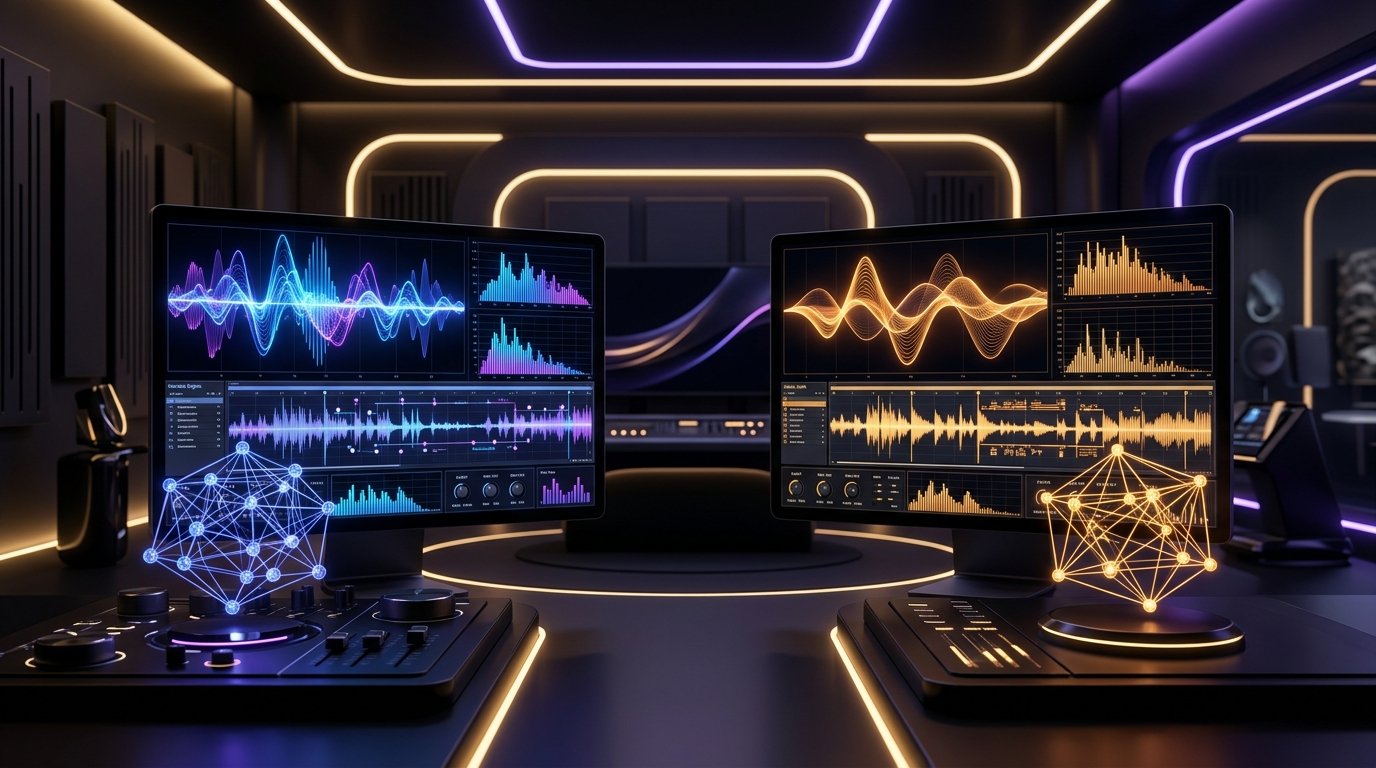
In the generative audio landscape, the battle between suno ai vs udio defines the modern frontier of AI music composition, pitting Suno's holistic song structures and expressive vocal synthesis against Udio's crystalline instrumental soundstage and modular arrangement workflows.
The emergence of foundation models capable of generating commercial-grade audio directly from natural language prompts has disrupted the traditional music production pipeline. While early generative music systems generated primitive MIDI arpeggios or low-bitrate ambient textures, current frontier engines synthesize full-frequency stereophonic masters featuring expressive lead vocals, harmonized backing layers, and multi-instrumental orchestration. For recording artists, sound designers, game developers, and commercial producers, selecting between Suno AI and Udio requires evaluating deep differences in acoustic modeling, production workflows, and distribution rights.
1. Neural Audio Architectures: Autoregressive Flow vs. Latent Diffusion
The sonic divergence between Suno AI and Udio is deeply rooted in their underlying mathematical approaches to neural audio synthesis. Both systems translate text prompts and custom lyric sheets into acoustic tokens, yet they execute the synthesis process through fundamentally distinct engineering pipelines.
Suno AI utilizes an end-to-end autoregressive transformer architecture trained on broad multimodal audio-text corpuses, mirroring the foundational prompt-completion paradigms seen in generative transformer models pioneered by OpenAI. This architecture enables Suno to maintain exceptional long-range structural memory across multiple minutes, ensuring that melodic motifs introduced in an opening verse naturally resolve during the chorus and bridge. However, autoregressive token prediction can introduce minor temporal blurring during rapid multi-instrument transients.
Udio, engineered by former Google DeepMind researchers, approaches sound synthesis using continuous latent diffusion models. Similar to image diffusion architectures, Udio starts from structured acoustic noise and progressively denoises the representation into pristine high-resolution spectrograms. This yields razor-sharp transient attacks, remarkable separation between drum transients and melodic synths, and expansive stereo width that frequently rivals human studio mastering.
Architectural Insight: Continuous Latent Diffusion vs. Discrete Autoregressive Acoustic Modeling
The fundamental sound differences between Suno and Udio stem from their neural acoustic architectures. While Suno leverages a highly tuned autoregressive transformer framework optimized for global macro-structures and lyrical phrasing coherence, Udio utilizes specialized continuous diffusion pipelines derived from former Google DeepMind research. This distinction explains why Suno excels at natural melodic phrasing across an entire song, whereas Udio produces superior high-frequency micro-acoustics and spatial stereo clarity in complex instrumental textures.
2. Audio Quality & Vocal Realism: Formants, Cadence, and Timbre
Vocal synthesis is the primary proving ground for consumer and commercial AI music generation. Translating lyrical syntax into authentic human emotional delivery requires modeling subtle vocal formants, chest resonance, breath pauses, and micro-pitch pitch bends:
- Suno AI (v5.5 Audio Engine): Suno represents the gold standard for natural human vocal delivery. Its neural model captures organic vocal imperfections—such as breathiness, vocal fry, raspiness in rock genres, and soulful melisma in R&B—that make vocal tracks instantly convincing. The engine adheres tightly to syllable rhythm, minimizing awkward lyrical mispronunciations.
- Udio (v1.5 Audio Engine): Udio delivers pristine phonetic clarity, with vocals sitting sharply forward in the stereo mix. However, in sustained high-register passages or rapid hip-hop cadences, Udio can occasionally exhibit slight metallic or phase-shifted artifacts, giving vocals an overly polished, synthetic timbre unless heavily prompted.
- Multilingual Pronunciation: Both platforms demonstrate fluent capability across Spanish, Japanese, Korean, French, and German, though Suno handles vernacular slang and accent variations with greater idiomatic naturalness.
3. Instrumental Separation and Soundstage Depth
While Suno holds the advantage in vocal warmth, Udio counters decisively in instrumental complexity and acoustic depth. For producers composing orchestral scores, cinematic trailers, progressive rock, or intricate EDM, Udio's acoustic separation is unmatched:
- Dynamic Range & Stereo Field: Udio creates expansive left-right panning and spatial depth. Sub-bass frequencies remain tight and punchy without muddying the mid-range instrumentation, while cymbal crashes and reverb tails maintain pristine high-frequency air.
- Genre Nuance: Udio handles mathematically complex genres—such as modal jazz, math rock, synthwave, and classical counterpoint—with sophisticated harmonic transitions. Suno, by comparison, tends to apply radio-style master compression, producing energetic pop and rock tracks that sound commercially mixed but occasionally exhibit slight spectral crowding.
- Multimodal Audio Integration: Similar to advances in multimodal neural audio generation seen in Google NotebookLM, both platforms continue incorporating acoustic conditioning from uploaded hummed melodies, vocal audio prompts, and reference instrument tracks.
4. Comparative Matrix: Suno AI vs Udio
The table below provides an objective benchmark comparison of technical specifications, workflows, and production features across both leading platforms:
| Benchmark Dimension | Suno AI (v5.5 Engine) | Udio (v1.5 / Standard) | Editorial Winner |
|---|---|---|---|
| Vocal Realism & Formants | Superior emotional vibrato, human breath cadence, and organic lyrical pacing | Clear phonetic articulation; can occasionally exhibit robotic metallic timbre | Suno AI |
| Instrumental Soundstage & Clarity | Punchy radio mix; slight dynamic compression in dense acoustic tracks | Audiophile stereo width, pristine high-end separation, and nuanced dynamics | Udio |
| Song Structure & Composition | Generates cohesive 2-4 minute tracks with intuitive verse-chorus transitions | Generates 32-second modular clips; requires manual extension and stitching | Suno AI |
| Production Environment (DAW) | Full "Suno Studio" web DAW: in-line lyric timing, stem separation, audio covers | Tree-branch extension UI; granular prompt conditioning without full DAW tools | Suno AI |
| Export & Download Freedom | Full MP3/WAV audio, isolated stem multitracks, and video clip downloads | Restricted external downloads following major label institutional licensing | Suno AI |
| Commercial Pricing Tiers | Free (50 credits/day), Pro ($10/mo), Premier ($30/mo) | Free (limited), Standard ($10/mo), Pro ($30/mo) | Tie |
5. Production Workflows: Suno Studio vs. Udio's Modular Tree
The creative workflows of the two platforms appeal to entirely different producer mindsets. As detailed in our comprehensive guide to Suno AI's foundational architecture, Suno has transformed into a browser-based Digital Audio Workstation (DAW).
In Suno, users can generate a complete 3-minute song in a single pass, then open "Suno Studio" to isolate individual stems (vocals, drums, bass, instruments), re-record specific vocal bars, adjust pitch quantization, or generate stylistic covers. This cohesive, linear workflow empowers non-musicians and speed-oriented content creators to produce finished tracks in minutes.
Udio, by contrast, operates on an exploratory, clip-based branching architecture. Users generate an initial 32-second kernel, evaluate musical variations, and then extend the composition forward, backward, or insert an intro/outro. While this modular approach grants surgical control over musical development and key changes, assembling a cohesive 3-minute track can require dozens of iterations, making it feel more like modular sound synthesis than traditional songwriting.
6. The Download Factor, Licensing, and Copyright Governance
The decisive differentiator for professional creators in 2026 centers on audio export policies and copyright compliance. Both Suno and Udio faced high-profile copyright litigation from the Recording Industry Association of America (RIAA) and major labels over model training datasets.
Following commercial settlements, their distribution frameworks diverged significantly:
- Suno AI Export Freedom: Suno grants paying subscribers full commercial ownership of generated tracks and provides unrestricted downloads of high-definition WAV files, stems, and video visualizations. Creators routinely distribute Suno-generated tracks to Spotify, Apple Music, and YouTube without platform export friction.
- Udio Platform Containment: Udio's licensing agreements with major record labels led to significant restrictions on external audio and stem file exports. For many users, Udio has transitioned into an on-platform sandbox for musical exploration and social sharing rather than an external distribution pipeline.
- Enterprise Governance: For corporate brands and marketing agencies, implementing strict digital rights management and enterprise AI security architectures and legal compliance remains mandatory when deploying outputs from generative artificial intelligence systems in commercial broadcasts.
Conclusion
The comparative showdown between suno ai vs udio captures a foundational technological inflection point for generative creative media, highlighting how contrasting neural modeling paradigms shape the musical creative process. While Suno AI has evolved into a comprehensive digital production ecosystem prioritizing end-to-end song cohesiveness, human vocal warmth, and unfettered stem exports, Udio establishes an undeniable standard for acoustic resolution, pristine stereo placement, and modular genre exploration. Digital producers, recording artists, and multimedia creators must evaluate their creative objectives when choosing between these platforms: Suno serves as the ultimate fast-track songwriting workstation for complete radio-ready tracks, whereas Udio functions as an acoustic laboratory for intricate instrumentation and complex sound design. As generative music models continue advancing toward real-time multi-track stems, zero-latency MIDI synthesis, and legally verified training datasets, both engines will increasingly coexist across modern digital audio workstations. Understanding their relative architectural strengths empowers creators to leverage algorithmic composition not as an artistic replacement, but as an indispensable force multiplier for creative expression.
Frequently Asked Questions (FAQ)
Which is better overall: Suno AI or Udio?
Suno AI is generally better for complete, vocal-led songs and fast end-to-end music production thanks to its integrated Suno Studio DAW and full song generation. Udio is superior for complex instrumental music, pristine stereo soundstage separation, and modular audio experimentation.
Does Suno AI have better vocal quality than Udio?
Yes. Suno AI excels in vocal emotional realism, natural breath cadence, vibrato, and genre-specific vocal timbre. While Udio delivers clean phonetic articulation, its vocal tracks can occasionally exhibit a slight metallic or synthetic resonance compared to Suno's organic delivery.
Can I legally monetize and distribute songs made on Suno AI and Udio?
On Suno AI, paying subscribers on Pro and Premier tiers receive commercial rights and can download WAV files to distribute to streaming platforms. Udio's paid tiers also include commercial rights, though recent policy agreements with major labels have introduced restrictions on direct external audio downloads.
What is the difference between Suno Studio and Udio's workflow?
Suno Studio functions like a lightweight browser-based DAW where you can isolate stems, re-record bars, edit lyrics, and craft covers. Udio uses a modular branching tree system where you create 32-second audio clips and iteratively extend them forward or backward.
Can I export audio stems from Suno AI and Udio?
Suno AI provides native stem separation on paid plans, allowing users to export isolated vocals, drums, bass, and instrumental tracks. Udio previously offered stem downloads, but external stem export capabilities have been curtailed on certain account tiers.

Evelyn Vance
Former senior technology correspondent with over 14 years analyzing artificial intelligence, enterprise cloud infrastructure, and frontier computing.