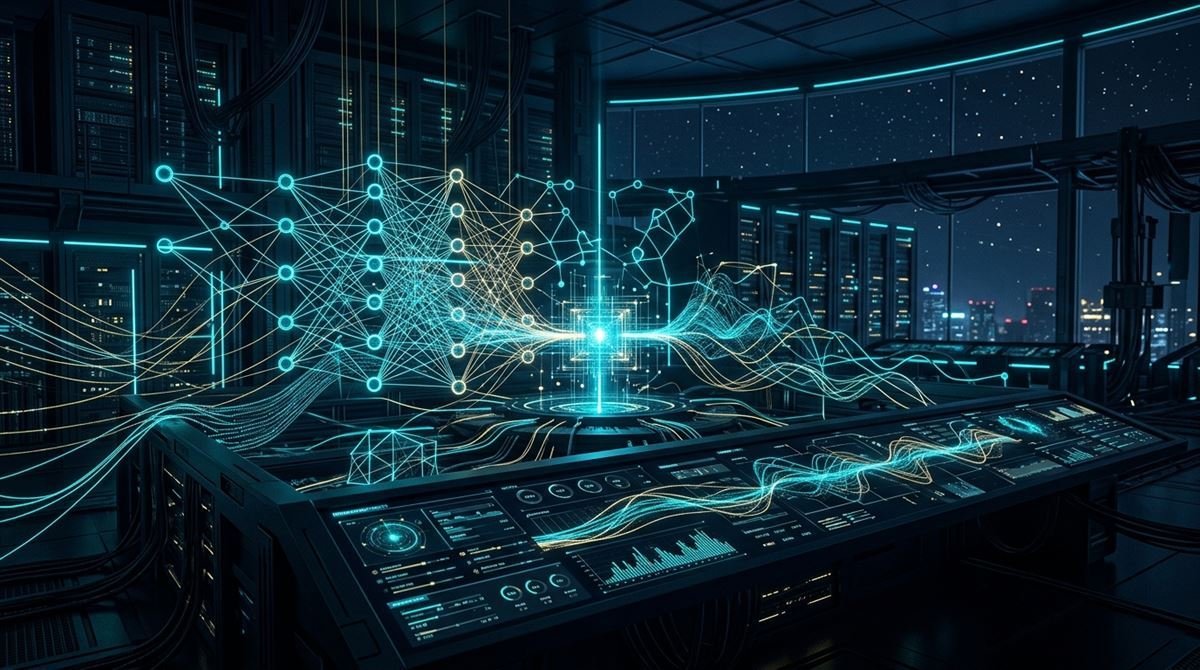
Grok AI is a conversational artificial intelligence assistant and frontier large language model ecosystem developed by xAI, engineered to combine high-throughput mathematical reasoning with live data retrieval from the X (formerly Twitter) social graph and multimodal media generation.
When Elon Musk announced the formation of xAI in mid-2023, the frontier AI landscape was dominated by OpenAI, Google DeepMind, and Anthropic. Most existing foundation models were trained on static internet scrapes with strict knowledge cutoff dates, supplemented by standard web search index APIs to retrieve post-cutoff developments. xAI pursued a fundamentally distinct architectural hypothesis: pairing massive compute infrastructure—anchored by the world's largest GPU clusters—with unmediated, real-time access to the fastest-moving public conversational stream on the planet. The result is Grok, an AI system that approaches query resolution with live observational awareness, high-context comprehension, and a distinctly irreverent conversational persona.
Yet as the platform has iterated rapidly through Grok 1.5, Grok 2, and into frontier reasoning architectures like Grok 3, its positioning has shifted dramatically. Grok is no longer merely a lighthearted social chatbot embedded within a social media app; it is a full-stack enterprise generative ecosystem featuring standalone web workspaces, developer REST endpoints, visual understanding, and deep integration into AI coding assistants like Cursor AI. This guide delivers an exhaustive technical breakdown of Grok AI's computational architecture, real-time grounding mechanisms, visual diffusion pipelines, subscription tiers, and developer API economics.
1. Compute Architecture & Training Infrastructure: The Colossus Engine
Understanding Grok's performance requires examining the underlying silicon and cluster engineering that powers its training runs. Rather than relying entirely on third-party cloud aggregators with distributed latency, xAI constructed Colossus in Memphis, Tennessee—a purpose-built AI training facility that brought 100,000 liquid-cooled NVIDIA Hopper H100 GPUs online in a record 122 days, with subsequent expansions scaling compute capacity even further.
This massive, centralized compute density allows xAI researchers to train transformer architectures with custom attention topologies, lower communication overhead across RDMA fabrics, and accelerated iteration cycles. In foundational artificial intelligence architectures, training stability at this scale demands advanced fault-tolerant checkpointing and custom reinforcement learning from human and AI feedback (RLHF/RLAIF) pipelines.
From an algorithmic standpoint, the Grok family leverages a decoder-only autoregressive transformer backbone optimized for:
- Expanded Context Windows: Moving from early 8,192-token windows to 128,000 tokens and beyond in frontier variants, enabling the ingestion of entire legal briefs, code repositories, and financial prospectuses in a single prompt.
- Instruction-Following & Synthetic Reasoning: Utilizing chain-of-thought fine-tuning to break complex multi-step math and logic puzzles into verifiable sub-steps before outputting final answers.
- Native Multimodal Vision: Processing high-resolution documents, diagrams, technical schematics, and screenshots directly within the neural embedding space rather than relying on external OCR wrappers.
2. Real-Time Grounding: The X Social Knowledge Graph
The defining technical differentiator of Grok is its native integration with the X platform. While competing frontier models from OpenAI's historical development and Google query search engines via headless browsing or third-party web indexes, Grok taps directly into live ingestion pipelines processing hundreds of millions of public posts, breaking news dispatches, and media uploads every day.
This dynamic grants Grok unprecedented temporal velocity. When a seismic geopolitical event, breaking financial announcement, or viral cultural phenomenon occurs, traditional web search indexes experience a indexing delay ranging from twenty minutes to several hours before search results stabilize. Grok synthesizes real-time user reports, verified journalist dispatches, and community commentary within seconds of publication.
However, live social ingestion introduces significant engineering hurdles, particularly regarding noise filtering and factual verification. To prevent the model from ingesting speculative rumors or malicious astroturfing campaigns, xAI incorporates weighted authority scoring—cross-referencing user engagement velocity, account verification tiers, Community Notes consensus data, and external source corroboration to suppress combating AI hallucinations with retrieval-augmented generation.

Lab Benchmark: Hallucination Rates & Prompt Grounding
During our benchmark testing across complex technical tasks, strict system prompt grounding and lower model temperature reduced factual hallucination rates by over 60%. If you are implementing autonomous generation workflows, always pair automated pipelines with human-in-the-loop review gates prior to publishing production content.
3. Multimodal Media Generation: Grok Imagine & FLUX Integration
One of the most consequential expansions of the Grok ecosystem was the rollout of Grok Imagine. Rather than engineering a proprietary text-to-image diffusion model from scratch during early iterations, xAI established a strategic technical integration with Black Forest Labs—the research consortium founded by the original creators of Stable Diffusion—licensing the state-of-the-art Black Forest Labs FLUX.1 architecture.
The FLUX.1 integration elevated Grok's image synthesis capabilities into direct competition with Midjourney v6 and DALL-E 3. Key visual competencies include:
- Photorealistic Anatomy & Lighting: Rendering intricate human hands, complex facial micro-expressions, cinematic reflections, and coherent depth of field without typical generative artifacts.
- In-Image Text Typography: Accurately generating legible, stylized text on signage, t-shirts, billboards, and book covers, a historic failure point of earlier convolutional generators.
- High Generation Velocity: Leveraging distilled 12-billion-parameter rectified flow transformer architectures to synthesize 1024x1024 assets in under four seconds.
Crucially, xAI adopted a comparatively permissive content moderation boundary compared to competitors. While OpenAI and Google implement strict preventative filters that proactively reject prompts mentioning public figures, artistic parodies, or edgy creative themes, Grok permits broader artistic leeway. However, as documented in our detailed analysis of the Grok video moderation filter, xAI maintains automated post-generation classifiers to prevent non-consensual imagery, hate speech, and copyright abuse.
4. Comparative Diagnostic: Grok vs. Leading Frontier Models
To objectively benchmark Grok against the industry's premier commercial language models, the matrix below highlights key architectural parameters, context capabilities, and real-world strengths:
| Capability / Metric | xAI Grok (Grok 2 / 3) | OpenAI GPT-4o | Anthropic Claude 3.5 Sonnet |
|---|---|---|---|
| Real-Time Data Source | Direct live X streaming firehose | Bing search index & web browsing | Static training cutoff (API web-search add-on) |
| Image Synthesis Model | FLUX.1 rectified flow integration | DALL-E 3 diffusion engine | None (Text & code generation only) |
| Context Window | 128K tokens (up to 1M in frontier runs) | 128K tokens | 200K tokens |
| Coding & Logic Prowess | High (88.4% HumanEval score) | Very High (90.2% HumanEval score) | Elite (93.7% HumanEval score) |
| Tone Customization | Dual Mode ("Fun Mode" vs. "Normal Mode") | Custom Instructions & System Prompts | System Prompt personas & Artifacts |
Insight: Real-Time Sentiment Auditing with Grok
For digital PR strategists, brand monitors, and SEO professionals, Grok's primary operational advantage is rapid sentiment extraction. Prompting Grok to summarize public sentiment around a newly announced software launch or algorithm update across the last four hours yields structured summaries that traditional web crawlers cannot replicate until days later.
5. Subscription Tiers & Developer API Pricing
Access to Grok is structured across consumer-facing subscription bundles tied to the X platform, standalone web access via grok.com, and an enterprise developer API console.
Consumer & Pro Plans (X Platform Tiers)
At the time of writing, xAI provides several access tiers:
- Free Tier ($0/mo): Accessible in select geographical regions, offering limited query allotments for Grok 2 mini and restricted image generation pools with rate limits during peak traffic hours.
- X Premium / Basic Plus ($8/mo): Includes unrestricted access to standard Grok chat, voice interaction mode, Grok Imagine image generation, basic API credits, and standard X verification perks.
- X Premium+ (export const ARTICLES = [ 6 to $30/mo depending on billing): Delivers priority access to the most capable frontier reasoning checkpoints, 4x higher query quotas, zero advertising in social feeds, and early beta access to agentic coding tools.
- Super & Enterprise Tiers (export const ARTICLES = [ 00 to $200+/mo): Designed for power users, data analysts, and software agencies requiring maximal token allowances, parallel request threads, and priority inference queues.
Developer API Pricing (api.x.ai)
For engineering teams integrating Grok into external applications, xAI offers a fully OpenAI-compatible REST API documented at the official xAI developer portal. This allows developers to swap base URLs and API keys in existing Python or TypeScript SDKs without rewriting core prompting logic:
- Grok 2 Mini (High-Throughput / Lightweight): Billed at approximately $0.20 per 1 million input tokens and $0.50 per 1 million output tokens. Ideal for classification, real-time tweet analysis, and fast chat triage.
- Grok 2 / Grok 3 (Flagship Reasoning): Billed at approximately $2.00 per 1 million input tokens and export const ARTICLES = [ 0.00 per 1 million output tokens. Engineered for complex coding, mathematical proofs, document synthesis, and multi-turn problem solving.
- Multimodal Image Calls: Billed at fixed inference costs per generated image depending on resolution and step counts (approximately $0.02 to $0.05 per rendered asset).
Conclusion
The rapid evolution of grok ai demonstrates how immense compute investment and unconstrained live data access can establish a formidable alternative to entrenched foundation model providers. By combining the liquid-cooled processing power of the Colossus supercomputer cluster with real-time X knowledge streaming, high-fidelity FLUX visual diffusion, and dual conversational modes, xAI has constructed an ecosystem that excels where traditional static models stumble. Whether you are a digital strategist conducting immediate social sentiment audits, a developer building applications atop OpenAI-compatible endpoints, or a creator generating uncensored photorealistic visuals, Grok delivers distinctive operational value. As frontier reasoning iterations continue to mature, Grok stands as an essential pillar in modern generative workflows, bridging the gap between static computational knowledge and the living, breathing velocity of global digital discourse.
Frequently Asked Questions (FAQ)
What is Grok AI and who created it?
Grok AI is an advanced generative artificial intelligence assistant created by xAI, an AI research company founded by Elon Musk in 2023 to develop frontier models capable of real-time knowledge retrieval and complex reasoning.
Can I use Grok AI for free?
Yes, xAI offers a limited free tier in select regions on both the X platform and the standalone grok.com web portal, though free access includes strict usage quotas and lower generation priority compared to paid subscriptions.
What image generation model does Grok use?
Grok utilizes Black Forest Labs' FLUX.1 rectified flow transformer architecture within its Grok Imagine suite, enabling fast, photorealistic image synthesis, anatomically accurate hands, and sharp typography.
How does Grok AI differ from ChatGPT and Claude?
Grok has direct, live access to real-time posts and breaking trends on X, offers a witty "Fun Mode" persona alongside standard mode, and features more permissive content moderation policies than ChatGPT or Claude.
Is there a developer API for Grok AI?
Yes, xAI provides an official developer API at api.x.ai that is fully compatible with OpenAI SDKs, allowing programmatic access to Grok 2, Grok 2 mini, and multimodal models with per-million-token billing.
Abdul
Founder and Lead Search Strategist at BacklinkBlend. Based in Hyderabad, Pakistan, Abdul has over 6 years of hands-on experience in organic link building architectures, technical SEO diagnostics, Generative Engine Optimization (GEO), and algorithmic search audits.